Etude in G flat major
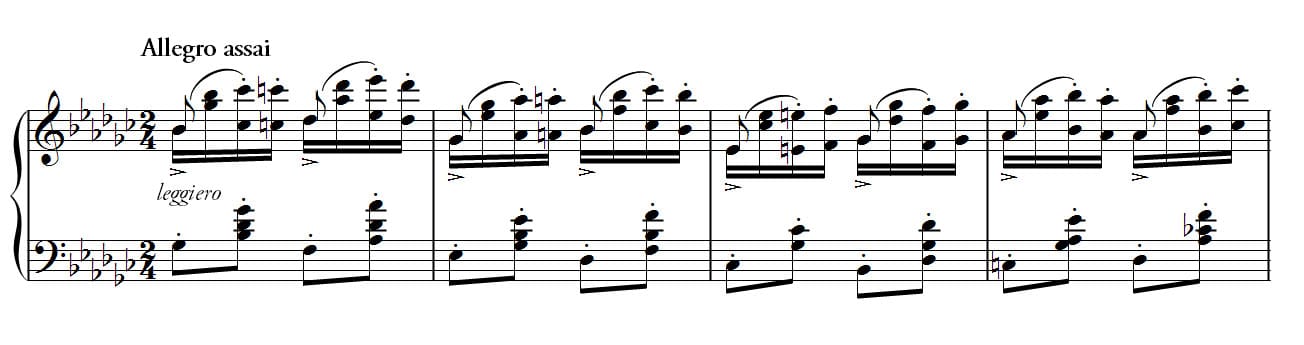
Etude in G flat major
The ninth Etude, in G flat major, has acquired the name ‘Butterfly’. It appears and then vanishes, lasting less than a minute. Within that time, it alters a single motif – the opening motif – almost one hundred times, in every way possible. It changes colour, jumping from key to key and from register to register, and flutters with octaves struck staccato. For Jachimecki, it is ‘as light as a soap bubble’. It became supremely popular thanks to Paderewski, who, by all accounts, played it quite peerlessly.Another famous pianist from those times, Leopold Godowsky, wrestled with a quite singular project to transcribe Chopin’s etudes for piano. More specifically, for ‘more difficult’ piano, demanding of the pianist a supreme level of technical skill. He made over fifty transcriptions, including of the Etude in G flat major. His idea was quite fiendish: he put together the two etudes written in the same key: the ‘Black Keys’ Etude from Op. 10 and the ‘Butterfly’ from Op. 25. The result – as one can well imagine – was quite remarkable, but perhaps more to be wondered at than to be admired.The popularity of the G flat major Etude has not waned. Occasionally, it has formed the starting point for jazz improvisations.Author: Mieczysław TomaszewskiA series of programmes entitled ‘Fryderyk Chopin's Complete Works’Polish Radio 2

Date:

1837

Opus:

Op. 25 No. 9

Competition LogoChopin Competition

International Fryderyk Chopin Piano Competition

100th anniversary of the Chopin Competition

Ministry of Culture and National Heritage

Funded by the Ministry of Culture and National Heritage

Edition 2025

  • Home

  • Newsroom

  • Awards

  • Jury

  • Calendar

  • Tickets

  • Regulations

  • Accompanying Events

  • Compositions

Information

  • For Competitors

  • Press Office

  • About Competition

Multimedia

  • Recordings

  • Photos

  • Audio

  • Chopin Courier

Organiser & partners

  • Institute

  • Partners

  • Privacy Policy

  • Contact