About II Chopin Competition Edition
Winners
Alexandre UninskyRussian Federation
1st Prize
Alexandre UninskyRussian Federation
2nd Prize
Imré UngárHungary
3rd Prize
Bolesław KonPoland
4th Prize
Abram LuferUkraine
5th Prize
Louis KentnerHungary
6th Prize
Leonid SagalovRussian Federation
7th Prize
Leon BoruńskiPoland
8th Prize
Teodor GutmanRussian Federation
9th Prize
Gyula (Julian) KárolyiHungary
10th Prize
Kurt EngelAustria
11th Prize
Emanuel GrossmanRussian Federation
12th Prize
Josef WagnerGermany
13th Prize
Maryla JonasPoland
14th Prize
Lily HerzHungary
15th Prize
Suzanne de MayèreBelgium
Jury
Marian DąbrowskiPolska
Richard RösslerNiemcy
Marguerite LongFrancja
Stanisław NiewiadomskiPolska
Franciszek *BrzezińskiNo data from API
Józef TurczyńskiPolska
Adam WieniawskiPolska
Carlo ZecchiWłochy
Roman JasińskiPolska
Zbigniew DrzewieckiPolska
Paul WeingartenCzechy
Józef ŚmidowiczPolska
Magda TagliaferroBrazylia
Jerzy ŻurawlewPolska
Karol SzymanowskiPolska
Juliusz Kaden-BandrowskiPolska
Maurice RavelNo data from API
Arthur de GreefBelgia
Zofia RabcewiczPolska
Alfred Höhn Niemcy
Eugeniusz MorawskiPolska
Joseph MarxAustria
Information
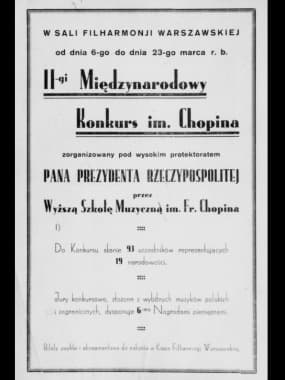
The 2nd International Fryderyk Chopin Piano Competition was held, as the organisers had originally planned, five years after the first. In March 1932, 89 pianists from 18 countries arrived in Warsaw. The Competition drew huge interest among the public and attracted correspondents from various corners of the world. Outstanding musical figures from abroad were invited to participate in the work of the jury. Guest of honour was Maurice Ravel, who in a concert on 11 March conducted a performance of his works: the Piano Concerto in G major and La valse.
During the final, there was an unprecedented occurrence: due to a protest from the Hungarian pianist Imré Ungár, who refused to accept equal First Prize with Alexander Uninsky, lots were drawn.
The blind Hungarian pianist was not favoured by fortune, however, drawing Second Prize.
During the Competition, a poll was held to find the best, most popular piano among the instruments on which the young pianists had played. The winner was a Viennese Bösendorfer.
Plakat
In his 1932 poster, Stanisław Ostoja-Chrostowski used a traditional poster layout: dates on the sides, a block of text at the bottom, and Chopin at the top. He applied white paint to the sides of the composer's profile and medallion, enhancing their visual prominence.