NEWS
Chopin for the participants of the Warsaw Uprising
There is much evidence in Fryderyk Chopin's biography of his deep attachment to his homeland. Writing to his family from Vienna at the age of 21, he makes this clear declaration: ‘Malfatti [i.e. the imperial court physician Johann Malfatti, who introduced the young composer to the circles of the artistic elite of Vienna] attempts in vain to convince me that every artist is a cosmopolitan. Even if that were the case, as an artist I am still in the cradle, but as a Pole I have begun my third decade.’ After nearly two decades in exile, his patriotic commitment had not weakened – having learned about the liberation movements in Greater Poland at the threshold of the Spring of Nations, he shared his hope with Julian Fontana: ‘There will be no avoiding frightful things, but at the end of all this there is Poland — splendid, great, in a word: Poland.’
Chopin demonstrated his strong sense of national identity not only in words but also in deeds. Upon arriving in Paris, he consciously did not renew his passport – he would have had to formally list himself as a subject of the Russian Tsar – thus voluntarily joining the ranks of political refugees. He gave charity concerts for emigrants, maintained constant contact with the Polish community in Paris, considered it an honour to join the Polish Literary Society, and supported his compatriots financially. He was unable to return to Warsaw – but, in accordance with his wishes, his heart rested there, brought by the composer’s sister, Ludwika Jędrzejewiczowa, and buried in the Basilica of the Holy Cross on Krakowskie Przedmieście Street.
Chopin’s nationality and dedication to Polish causes were clearly recognized by his French and international circles. In the opinion of Franz Liszt, ‘he filled [musical] forms with the feelings peculiar to his country, because the expression of the national heart may be found under all the modes in which he has written, that he is entitled to be considered a poet essentially Polish.’ In one of Hector Berlioz’s texts, we read: ‘he sang […] the sufferings of a distant homeland, beloved Poland, always ready to conquer and always oppressed.’ Ernest Legouvé, writing in the Revue et Gazette musicale, stated: ‘in the graceful and tender melodies, one hears the sounds of battle, menacing knightly marches, distant memories of a heroic homeland, the painful echo of Warsaw’s sobs. In Chopin, we have two beings: a patriot and an artist, and the soul of the former animates the genius of the latter.’ Robert Schumann saw in the music of Fryderyk ‘a distinct, original nationality, namely Polish,’ Heinrich Heine expressed the belief: ‘Poland gave him a chivalric soul and its historical suffering,’ and Wilhelm von Lenz assessed that his teacher ‘gave Poland, composed Poland’ in his works. (‘Lenz, as if unconsciously repeating in different words a phrase from Norwid’s Chopin’s Piano, which he himself was not familiar with: “And there was Poland in it…”’ writes Professor Mieczysław Tomaszewski, to whom we owe the collection of quotes cited here.)
Chopin’s oeuvre was interpreted as a symbolic embodiment of Polishness by the composer’s compatriots even during his lifetime – and later, artists in each succeeding decade expressed this belief with the temperament characteristic of their era: ‘From Zygmunt Noskowski, Stanisław Przybyszewski (Szopen a Naród, 1910), and Ignacy Jan Paderewski (“[…] in Chopin […] the soul of the nation was expressed […]”, 1910), to Karol Szymanowski and Stefan Kisielewski (“[He is] Polish, archly Polish”),’ Professor Tomaszewski enumerates.
His music brought hope and spurred people to fight – as so often in the tragic history of Poland in the 20th century. During World War II, Nazi occupiers sensed such power in these works that performing Fryderyk Chopin’s music was punishable by death. Both the greatest Polish artists and amateurs performed Chopin’s compositions at secret concerts in cafés and private apartments.
***
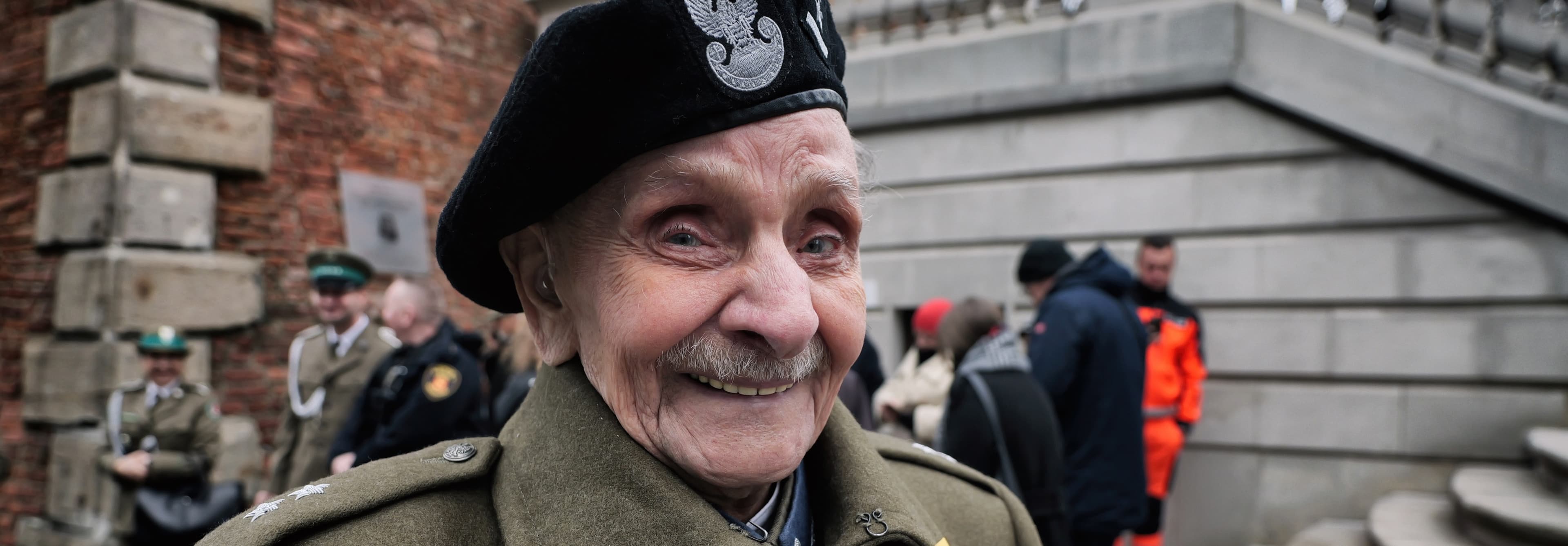
On Thursday, December 4th, the Fryderyk Chopin Museum hosted a unique concert in tribute to the Warsaw Uprising insurrectionists: the works of the brilliant composer for the heroes of 1944 were performed by Piotr Pawlak, winner of the 2nd International Chopin Competition on Period Instruments in Warsaw and a participant in this year’s 19th International Fryderyk Chopin Piano Competition, highly praised by critics and audiences. This young virtuoso’s magnificent performance in the third stage of the 19th Competition was described by Jed Distler, a reviewer for the prestigious magazine The Gramophone: ‘The reason few pianists take on Chopin’s solo edition of his Rondo à la Krakowiak, Op. 14, for piano and orchestra is that it’s virtually impossible. His [Pawlak’s] dazzling virtuosity and pinpointed articulation brought this rarity to ebullient life, effortlessly distinguishing solo and tutti textures. Then there were the Op. 17 Mazurkas. […] Pawlak is altogether […] idiomatic. He brings the left hand’s rhythmic underpinning to the fore without ever hitting you over the head or stating the obvious. Yet he also scales back the accompaniments when the right hand weaves elaborately decorative phrases, or when polyrhythmic phrases appear.’
Both the Rondo and the Mazurkas, Op. 17, were included in today’s concert program. They were complemented by three works: the Fantaisie-Impromptu in C-sharp minor, Op. posth. 66 – poetically described by Marie-Paule Rambeau as ‘an uninterrupted lyrical breeze,’ and wrote by Chopin in Baroness Frances d’Este’s album – the Prelude in C-sharp minor, Op. 45 (‘a consummate masterpiece, born entirely of the spirit of improvisation’ – in the words of Mieczysław Tomaszewski), and the Allegro de concert, Op. 46 – of which Chopin reportedly said: ‘It’s the piece I shall play in my first concert upon returning home in the free city of Warsaw.’